
Bible Study Notes 3/23/26
Palm Sunday of the Lord's Passion

Every Monday night for a few hours, I attend a Bible study group that meets at the local Fatima Shrine. The shrine’s rector leads the group as we analyze and share our thoughts on the readings for the upcoming Sunday Mass. I’m hopeful that sharing my notes will help me continue to think and pray with these passages before Mass, and will also give you an opportunity to delve a little deeper into the Word of God.
Disclaimer: Since my note-taking is somewhat erratic and illegible, I’ll add any information that I may have missed or mistranscribed during the meeting. Please keep in mind that this is not intended to be a comprehensive study that examines every possible aspect of the readings and tells you what is most important. Instead, these are just points that made an impact on me, or as a group, we explored. Think of these notes as adding to your background knowledge of the passages, so when you go to pray with them, something new may distinguish itself that did not before.
Readings for Palm Sunday of the Lord’s Passion
Isaiah 50:4-7
Philippians 2:6-11
Matthew 21:1-11
A prayer before reading and studying these passages in preparation for Holy Mass by St. John Chrysostom:
O Lord Jesus Christ, open Thou the eyes of my heart, that I may hear Thy word and understand and do Thy will, for I am a sojourner upon the earth. Hide not Thy commandments from me, but open mine eyes, that I may perceive the wonders of Thy law. Speak unto me the hidden and secret things of Thy wisdom. On Thee do I set my hope, O my God, that Thou shalt enlighten my mind and understanding with the light of Thy knowledge, not only to cherish those things which are written, but to do them; that in reading the lives and sayings of the saints I may not sin, but that such may serve for my restoration, enlightenment and sanctification, for the salvation of my soul, and the inheritance of life everlasting. For Thou art the enlightenment of those who lie in darkness, and from Thee cometh every good deed and every gift. Amen.

Isaiah 50:4-7
The Lord GOD has given me
a well-trained tongue,
that I might know how to speak to the weary
a word that will rouse them.
Morning after morning
he opens my ear that I may hear;
and I have not rebelled,
have not turned back.
I gave my back to those who beat me,
my cheeks to those who plucked my beard;
my face I did not shield
from buffets and spitting.The Lord GOD is my help,
therefore I am not disgraced;
I have set my face like flint,
knowing that I shall not be put to shame.
This is the third Servant Song, better known as the Song of the Suffering Servant.
Isaiah 42:1-7 – The Servant, a Light to the Nations
Isaiah 49:1-7 – The Servant’s Mission
Isaiah 50:4-9 – The Servant’s Humiliation and Vindication
Isaiah 52:13-53:12 – The Suffering ServantThere are scriptural debates surrounding the servant songs and whether they are actually extracts from ‘true’ Isaiah.
The suffering servant is taken to be indicative of Christ, but in the immediate context, it is probably Isaiah speaking in 1st person POV.
Christ is the fulfillment of every servant song, but especially this one.
In the immediate context of the passage, Isaiah is warning the people about the coming collapse of the kingdom/current way of life/society as a whole.
Adding a religious overtone to the destruction of society adds a level of irrationality and unreasonability in the common man.
We detoured a bit into talking about the current situation in the Middle East and the similarities between the exile of the Southern Kingdom to the east and the current forced displacement of thousands of Lebanese (an amount of people 4x the size of the City of Buffalo).
Verse 4 is reminiscent of the first words spoken in the morning after grand silence all night in religious communities. During Morning Prayer (Matins usually), the words from Psalm 51:15 are spoken, “O Lord, open my lips, and my mouth shall declare your praise.”
The passage begins with the comforting image of a morning spent with the Lord, quickly devolving into the day’s evils, as those who do not want to receive the prophet’s words beat him.
As much as we may desire an even-keeled debate about ideas and have others accept them amiably, in our current society, there is a certain level of intolerance towards those who point out what goes against the grain of everyday life. It can become dangerous to threaten societal norms with the possibility of physical harm.
Think of the Jesuit missionaries who traveled to Japan and challenged the ideas behind everyday practices. In fact, you can think of any missionary in antiquity or modernity who has gone into hostile territories, seeking to share the Gospel, despite any harm that may come to them.
Repentance can certainly bring about a strong response.
We discussed living examples of those willing to become both red and white martyrs for the sake of the Church (Those in Uganda, Cardinal Zen, Pizzaballa’s comments on the Middle East Christians, etc.).
I cannot for the life of me remember why Kierkegaard was brought up, but he was definitely called the melancholy Dane at some point.
Shame is an adopted mindset. Think of Adam and Eve in the Garden of Eden; they were not ashamed of their nakedness until the “eyes of both were opened” (Gen 3:7). Holding certain beliefs, or practicing your religion, does not merit shame; if you feel it, it is because you first accepted that there is something shameful within it that others would deem repulsive to some degree.
Like Isaiah, who set his “face like flint,” Jesus similarly “set his face to go to Jerusalem,” invoking sentiments such as “the die has been cast” or “crossed the Rubicon” (Lk 9:51).
Jesus’ human nature must have been acutely aware that each miracle He performed brought Him one step closer, one day closer, to His Passion and Death. Even amidst the joy of healing, He must have felt some trepidation and anxiety at the thought of everything He was going to go through and that His hour was quickly approaching. I think of Gethsemane, when Jesus sweated blood, the stress literally causing his blood vessels to burst and mix with His sweat (Lk 22:44; see also Heb 2:14-15).
The main point of this passage is that the Lord is our strength to overcome the challenges of the world (verse 9).
God comes to Isaiah’s defense, who firmly believes he can endure any physical suffering with God on his side.
The passage is reminiscent of Luke 4:24, “Truly, I say to you, no prophet is acceptable in his own country.”
Slight tangent, but the words of Pope Francis on the length of a priest’s humility were discussed, and how not only should they not be too long, but the priest does not need to upset the apple cart every single week. There is a delicate balance in parish life between guiding and admonishing the flock.
Philippians 2:6-11
Christ Jesus, though he was in the form of God,
did not regard equality with God
something to be grasped.
Rather, he emptied himself,
taking the form of a slave,
coming in human likeness;
and found human in appearance,
he humbled himself,
becoming obedient to the point of death,
even death on a cross.
Because of this, God greatly exalted him
and bestowed on him the name
which is above every name,
that at the name of Jesus
every knee should bend,
of those in heaven and on earth and under the earth,
and every tongue confess that
Jesus Christ is Lord,
to the glory of God the Father.
As a group, we have studied this passage in depth many times, so we decided not to discuss it in favor of taking more time with Isaiah and Matthew’s readings.
Matthew 21:1-11
When Jesus and the disciples drew near Jerusalem
and came to Bethphage on the Mount of Olives,
Jesus sent two disciples, saying to them,
"Go into the village opposite you,
and immediately you will find an ass tethered,
and a colt with her.
Untie them and bring them here to me.
And if anyone should say anything to you, reply,
'The master has need of them.'
Then he will send them at once."
This happened so that what had been spoken through the prophet
might be fulfilled:
Say to daughter Zion,
"Behold, your king comes to you,
meek and riding on an ass,
and on a colt, the foal of a beast of burden."
The disciples went and did as Jesus had ordered them.
They brought the ass and the colt and laid their cloaks over them,
and he sat upon them.
The very large crowd spread their cloaks on the road,
while others cut branches from the trees
and strewed them on the road.
The crowds preceding him and those following
kept crying out and saying:
"Hosanna to the Son of David;
blessed is he who comes in the name of the Lord;
hosanna in the highest."
And when he entered Jerusalem
the whole city was shaken and asked, "Who is this?"
And the crowds replied,
"This is Jesus the prophet, from Nazareth in Galilee."
A fun fact that I again forgot how it tied back into our conversation: After the Bar Kokhba revolt, Jerusalem was rebuilt as Aelia Capitolina. The Romans had decided to employ fare piazza pulita, or make a clean sweep. I really should stop writing the fun facts in the margins and put them in context with the actual notes. I’ll do better, promise!
This passage is a fulfillment of Zechariah 9:9.
In verse 7, Matthew states that Jesus rode both the colt and the ass. Anyone wanna take a guess on how He did that?
This is technically based on a grammatical error, but St. Jerome would say it’s still the inspired Word. Kind of ironic considering his hesitancy with the deuterocanonical books. Just saying.
St. Jerome also states that an allegorical interpretation has the two animals representing the two nations Christ will bring together. The ass signifies Israel in its Old Covenant, and the colt signifies the Gentiles, new to God and His Law. Jesus leads them both, tethered together, into the heavenly Jerusalem (ICSB footnote on Mt 21:7).
Verses 1-2 are connected to Zechariah 14:4-5, with Jesus literally stepping onto the Mount of Olives.
Hosanna means ‘Save us!’ I know that most of you know this, but it doesn’t hurt to repeat it.
Jesus’ entry into Jerusalem mirrors that of Solomon’s: both are the Son of David (Mt 21:9; Prov 1:1); Jesus rides a colt, Solomon rides David’s mule (Mt 21:7; 1 Kgs 32-40); and both are met with crowds celebrating a new king (Mt 21:8-9; 1 Kgs 1:39-40).
Verse 9 is seen in Psalm 118:26.
Christ enters Jerusalem, and in the Matthean account, He immediately goes to cleanse the Temple (21:12-17). However, it lacks the Johannine/Indiana Jones action with Him braiding a whip.
I recounted part of the legend of the donkey bearing the mark of a cross on its back, which carried Our Lord.
“A poor farmer near Jerusalem owned a donkey far too small to do much work at all. He felt that he couldn’t afford to feed a worthless animal like this, one that could do him no good whatsoever, so at the supper table he told his family that he was going to kill the donkey. His children, who loved the little donkey, begged him to sell it rather than harm it. But the farmer said, “It’s wrong to sell an animal that can’t do a good day’s work.” Then his oldest daughter suggested, “Father, tie the donkey to a tree on the road to town, and say whoever wants it may take it for nothing.” And the next morning, that’s what the farmer did. Soon, two men approached and asked if they could have the donkey. “It can carry almost nothing,” the farmer warned them. “Jesus of Nazareth has need of it,” replied one of the men. The farmer couldn’t imagine what a great teacher would want with such a worthless donkey, but he handed it over. The men took the animal to Jesus, who stroked the grateful donkey’s face and then mounted it and rode away. So, on the day we call Palm Sunday, Jesus led his followers into the city of Jerusalem, riding on the back of a small, common donkey. The donkey so loved his gentle master that he later followed him to Calvary. Grief-stricken by the sight of Jesus on the cross, the donkey turned away but couldn’t leave. It was then that the shadow of the cross fell upon the shoulders and back of the donkey, and there it stayed. All donkeys have borne the sign of the cross on their backs since that very day.”1
The connection was made that Jesus spent His early days riding on the back of a donkey with Mary, and in the last few days of His life, He rode on the back of a donkey again, entering Jerusalem.
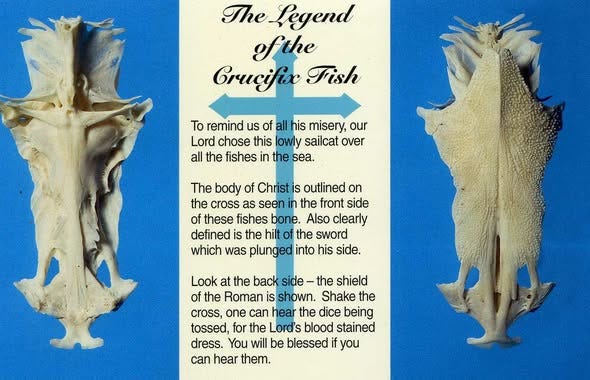
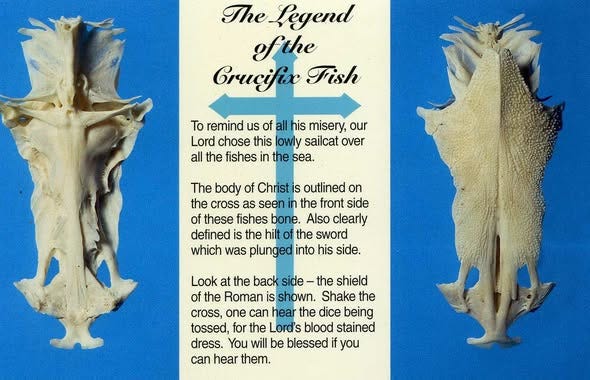
Another animal with an interesting connection to the cross is the Gafftopsail Catfish. I used to have one of these, but it broke when I moved back home with my parents. If you shook it gently, you literally could hear what sounded like dice being shaken. It was very cool.
Christ chose a donkey, not a horse. This was a deliberate choice to remain humble while possessing divine power. Akin to when Jesus was born in the manger. Also, when Christ was hanging on the Cross and did not remove Himself from it, even though He could have. He chooses the humblest of places and positions to reveal His love to mankind.
He also chooses a peaceful, albeit stubborn, creature, rather than the war horse the Messiah was expected to ride in on, as mentioned in Zechariah 9:10.


Next week, we will be taking a look at the readings for the Resurrection of the Lord for Mass During the Day: Acts 10:34a, 37-43; 1 Corinthians 5:6b-8; and John 20:1-9.
Talk to you soon,
Ryleigh
https://morningbrayfarm.com/2011/04/17/legend-of-the-donkeys-cross/
I also wondered about the colt and the donkey! I appreciate the insights from St Jerome, the allegory is quite cool